
Be Water, My Friend
July 1, 2026
By Satya Kari, Lilie Jeanneaux and Marion Pénigot-Ponzo
Project: Hydrology
Living and Working in a Forest Community: Satya’s Invitation to Sacha Isla
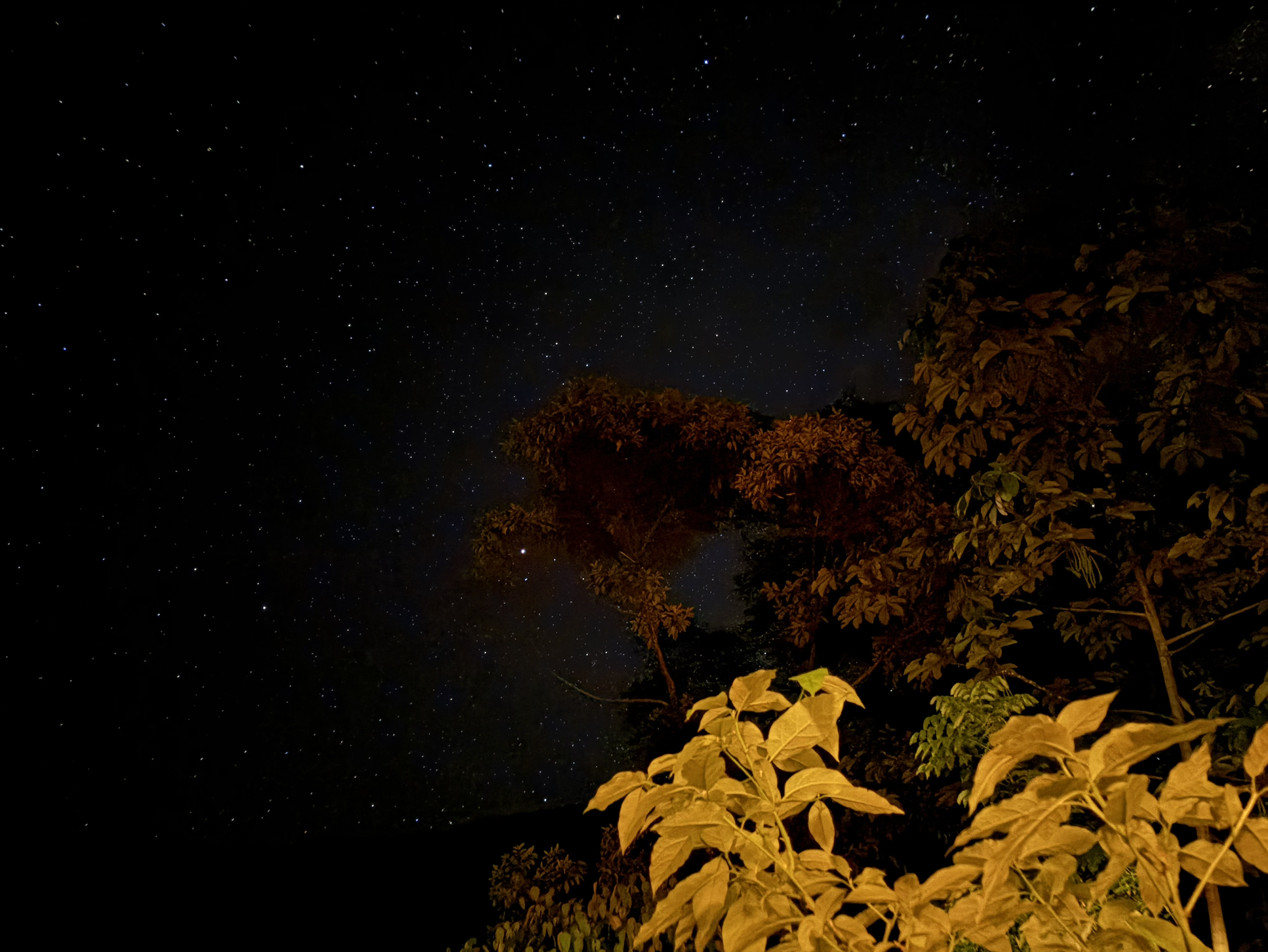
Picture this. You just finish an active, productive work day and are itching to go home to the comfort of your four walls and cushioned mattress. You open the door to your bedroom, only to realize that you are not alone at all. Whether it be an uninvited visitor near your sink, droppings gifted by a flying passer-by, or the darkness of the forest staring back at you, you always have company. This has been the daily experience of Satya, Marion, and Lilie, three interns who chose to spend their last summer as college students working on a regenerative hydrology project in the Peruvian Amazon.
A day in the jungle begins with a morning meeting or movement session with the Siendo Naturaleza team. This sets the tone, as we transition into morning rotas – a time when we serve the land, as a way of expressing our gratitude for all that it provides us. On some days, that can mean hiking up with a machete to remove brachiaria ruziziensis (an invasive African grass species) with Persi or harvesting yuca (a native cassava) from the soil with Marilú. On other days, it can mean cleaning the common bathrooms and Amigrillo, our hang-out space with WiFi, with Meyly or helping Lili prepare for meals in the kitchen.
The rest of the day is mostly spent in active collaboration with the team, either out on the land doing observations or in the Amigrillo doing targeted research. To ensure that the time we spend in the forest and on our laptops is purpose-driven and productive, our team frequently checks in with each other and documents each meeting. A big part of living and working together (in the same space) has been learning how to gently communicate our needs and keeping each other accountable to balance project work and personal care. Conflict is unavoidable, but we found that when dealt with correctly, it can bring us closer instead of tearing us apart.
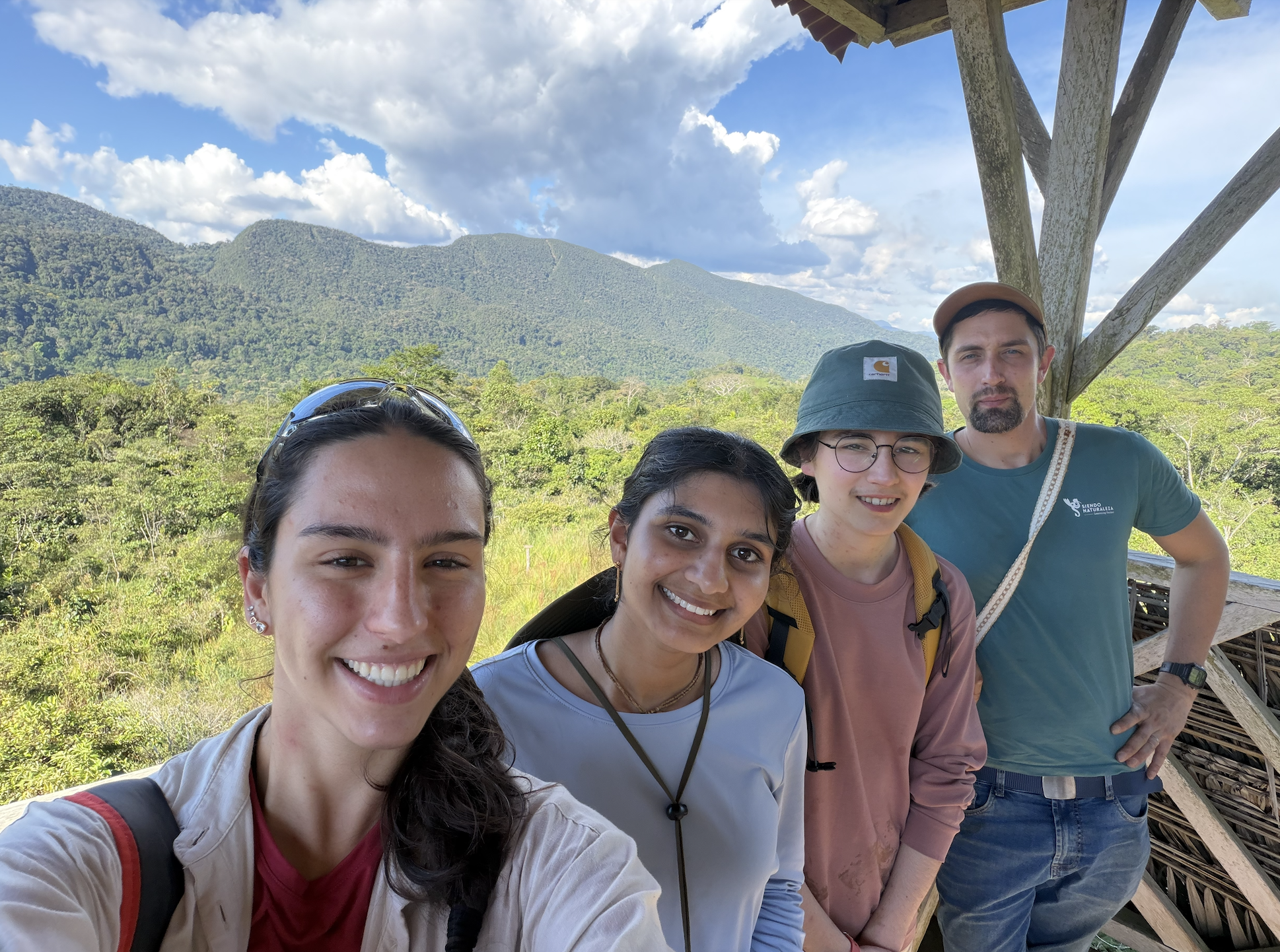
Our biggest strength as a team is unity in diversity. Each member brings a different expertise, perspective, and cultural context to the team. Marion and Lilie, Civil Engineering students from McGill University, bring their respective expertises in hydraulics and remediation of soil and water. Satya, an Environment and Sustainability student from Cornell University, brings her unique expertise in physical ecosystems connected to living communities. The beauty of diversity in our team goes beyond academic expertise, it extends to cultural contexts: from Spain, France, and India, to the United States and Canada. This diversity allows our work at Siendo Naturaleza to have both depth and breadth.
An unofficial member of our team that we have yet to introduce is the rain. It is the single largest influence for living and working in the forest, affecting everything from when we choose to do our laundry to when we run to observe water flow across the landscape. Rain is an extremely vital resource in the cloud forest, leading the entire hydrologic cycle. When asked for our contingency plan if it were to rain, our team’s response was “Rain is a part of our design process. We encourage it!”. For our project, it allows us to see the natural flow and movement of the water across the landscape.
Building Context and Creating Connections, as narrated by Marion
Keeping the observation lens on and not jumping into “fixing” is easier said than done.
During the two week-long virtual portion, our team focused the research on issues that we thought were relevant. However, upon reaching the land, we quickly realized that our focus was not pointed in the right direction. The perception we had of the jungle was one of dampness (which is true) and daily rain, and thus, that flooding would be our primary concern. Turns out, the jungle and its people are very well adapted and used to intense precipitation, a phenomenon they have been experiencing for millennia. There wasn’t a clear need for intervention on that front.
A critical piece was missing in our research: context.
We were stuck. We didn’t have the option of observing and living the land through its seasons, and, ours being a new project, little to build on top of. It was frustrating, not being able to find an answer immediately, something we had grown so accustomed to. Looking back, this discomfort is precisely what allowed us to go deeper into what we wanted our system to be, who it would affect, in what way, and to what extent. Once that was put on paper, something clicked and the next step became clear.
We had to find a new focus; a new need that we could tackle to improve life on the land, for both humans and wildlife. Water would be the center piece of our approach. We didn’t want to be the people who showed up and decided what was valuable or not based on our misguided notion of self importance. Or exclude the people who are actually deeply connected to this land.
To do so, we set up interviews with 7 members of the Siendo Naturaleza team and created a bank of 60 questions, across 6 different topics: water, flora, fauna, soil, infrastructure, and education. Each interview was personalized and targeted to the specific interviewee. Our goal was to go big and identify needs and areas of improvement across the board. We wanted to see how things connect together and draw deeper insights to build the context we were looking for. Our team counted on a native Spanish speaker. This allowed us to really delve into the interviews, read body language, and have a cultural middle ground that allowed us to better interpret answers, redirect questions on the spot, and correct anything lost or misinterpreted in translation.
A specific topic kept coming up: the dry season, the overarching theme responsible for much more than we previously realized. Growing longer and harsher, the dry season forces daily manual irrigation of the crops, a laborious and time demanding task. This is where we could act. Thus, the idea of developing a regenerative irrigation system was born: an intricate network of ponds that would promote habitat restoration, tackle erosion, improve water retention, and automate the irrigation of the land.
Reflections by Lilie: How do we Build Ponds that are Alive?
To paint a picture of Sacla Isla for the readers, the land is mostly covered by fast growing trees and plants, with a few patches still covered by brachiaria, the invasive grass. We are located on a slope between two main rivers. At the bottom of the valley, the Tiracu river has a large straight bed with huge rocks. The Santa Rosa river at the top, is smaller with a slower flow, cutting through the steep landscape and forming small creeks. In the cloud forest, the weather is unpredictable, a clear blue sky may suddenly transform into a shower of rain. The topography is constantly changing. We can see traces of previous streams that dried up, and newly formed pathways for the rivers that didn’t exist just a few months ago.
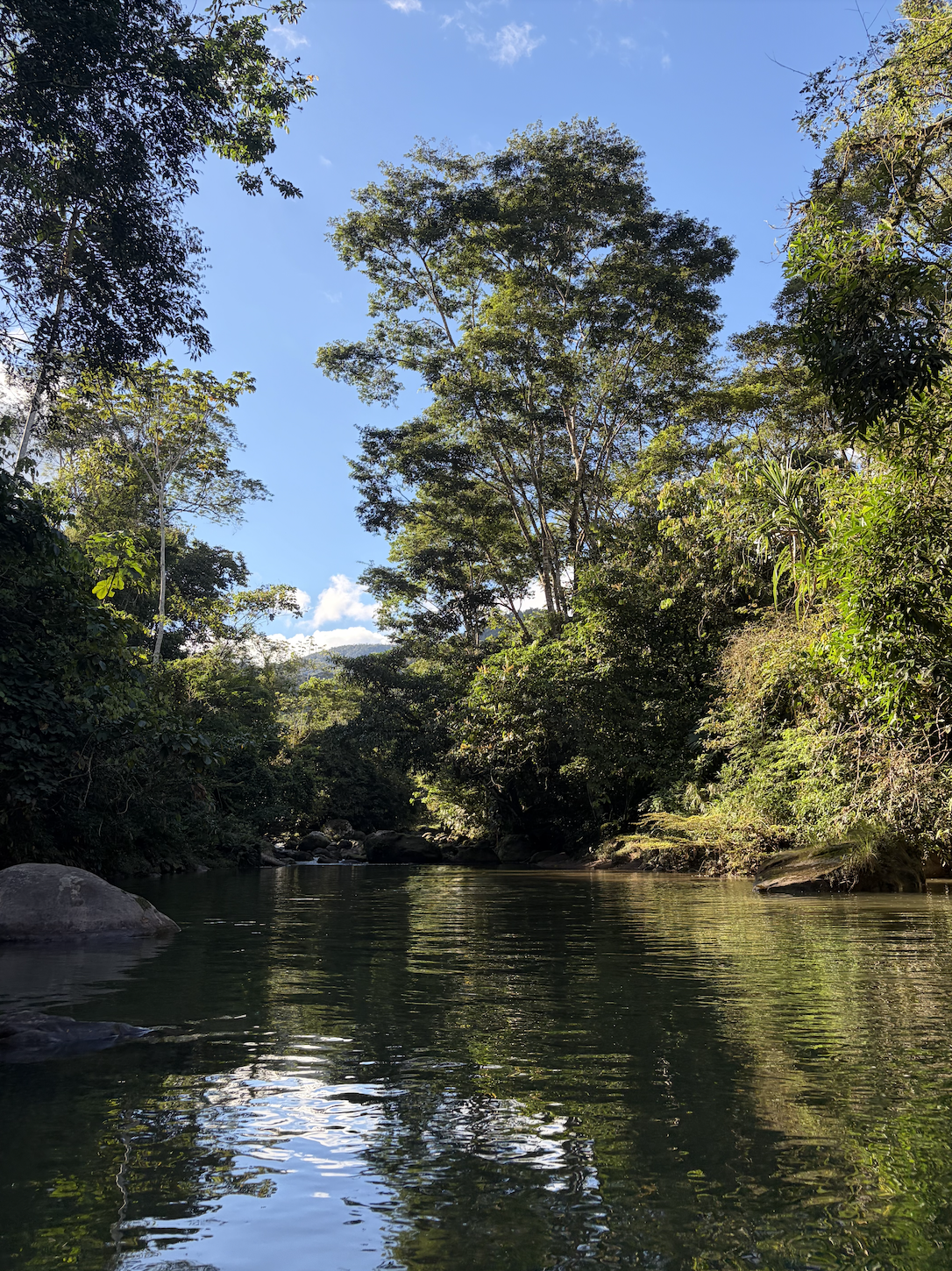
Because of the ever-changing nature of the environment we are in, taking the time to watch our surroundings without attributing meaning to them was an important skill for us to learn. Things may not always make sense the first time we encounter them. But the juxtaposition of observations in many areas and in different weather events slowly broadened our understanding of each piece in the system. For example, we first noticed an Amazonian palm tree species growing near water. Later, that led to learning that Mauritia flexuosa (commonly known as Aguajes regulate water levels by absorbing and releasing water through its roots.
When it rains at Sacha Isla, water does not stay long. It quickly flows overland, heavily eroding banks. This is one of the factors that shaped the idea of ponds that can slow water during the rainy season, and be used as a source for irrigation during the dry season. While also promoting the creation of different seasonal niches.
But how do we go about building wildlife ponds without machinery?
The first step is – again – observation, but this time more targeted. When creating a pond, it is important to be sure about where, why and how we are making it. We first began by walking around the Andenes, the main farming area requiring irrigation, and looking for potential areas where a pond could be dug. Among the sites, the one previously identified by RCI '25 intern, Ainsley Dey, was the best due to its direct position above the Andenes.
And this is where we’re at… :)
Satya, Marion & Lilie
Hydrology Team, RCI 2026