

Our Story
Our work began in 2018 with the stewardship of severely degraded land that we now know as Sacha Isla. We built strong relationships with our neighbors and community members, who are mostly migrants from the highlands of Peru. Together, in 2019 we formed a committee for the wellbeing and conservation of the Tiracu Valley. Although the committee ceased to exist in 2020, it was largely thanks to it’s formation that Siendo Naturaleza’s founder and a group of supporters facilitated the first educational experience for the children of the valley. In 2022 we officially became a formal, non-profit legal entity: Asociación Siendo Naturaleza.
Becoming of Place

Committee - August 2019
Stewarding the land
In 2017 Eliane Cohen, Founder of Siendo Naturaleza, met the land for the first time. She encountered a place absent of large trees and with compacted soil lacking in fertility. For 50 years the land had been used for monoculture and grazing. This was all about to change. In 2018 the land and Eliane entered a partnership where she, and others who came after, would become stewards of the place.

Project partners, husband and wife Eliane and George have been caring for Sacha Isla along with Persi, Marilú, and the Siendo Naturaleza team.
They both studied Ecological Design Thinking at Schumacher College in the UK, and their deep love for the Earth and for the cloud forest brought them together in 2020.
Eliane designs learning experiences and holds the purpose and vision of Siendo Naturaleza. George designs ecological buildings and adapts global farming practices to the local context. The product of their combined backgrounds, interests, expertise and networks is what Siendo Naturaleza Learning Center offers today: learning for the wellbeing of all.
LOVE IN ACTION
March 2024
November 2019
A SHIFT IN PERSPECTIVE
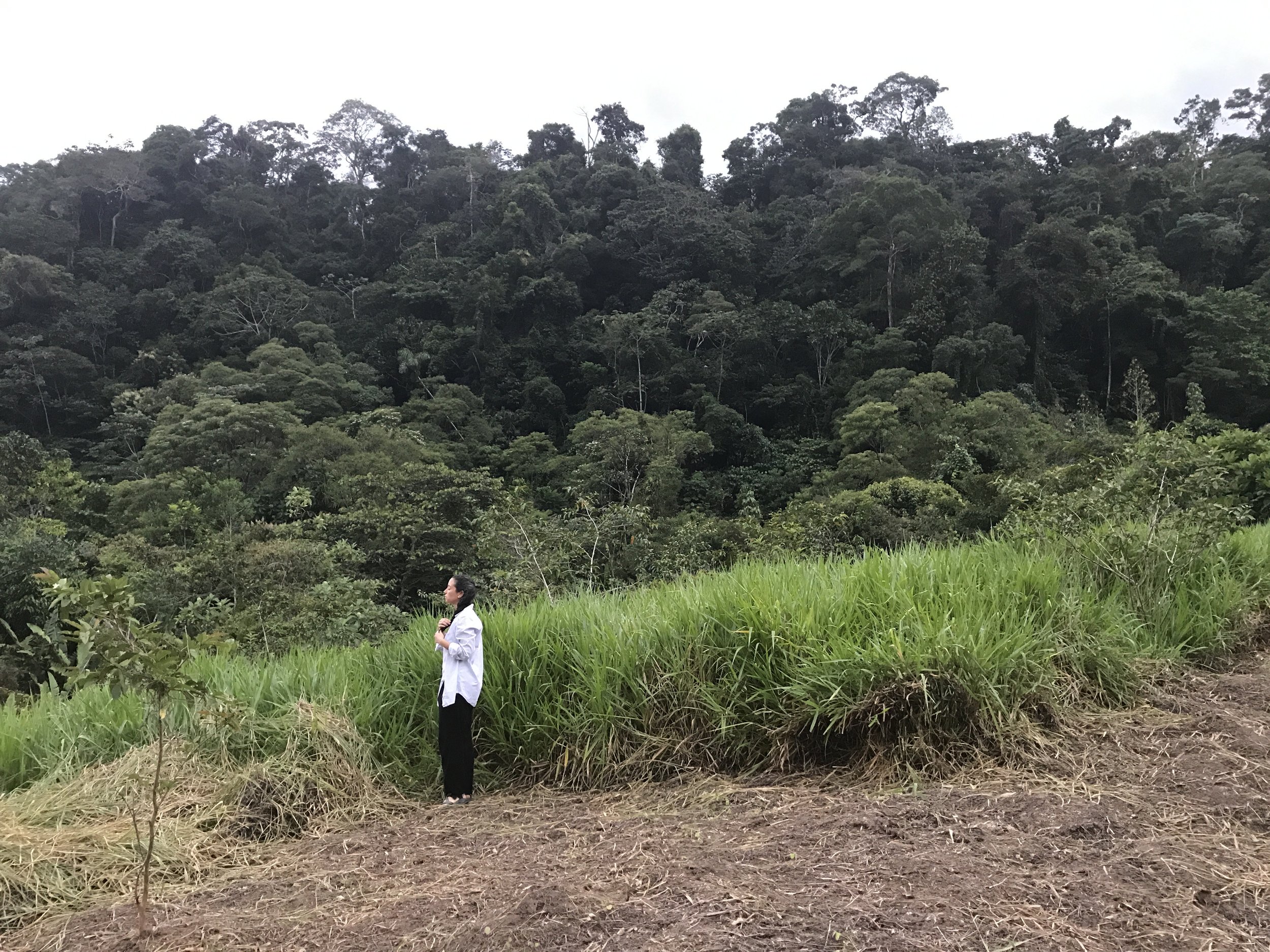
Eliane is standing on a recently cut patch of grass, that was like the one behind her. This grass that comes from Africa is called Brachiaria (Urochloa brizantha), and in Peru, it is an invasive species. It is planted to graze cattle and once it is rooted and soaking up the sun and the rain, it doesn’t allow other species to grow. In many regions of the Peruvian Amazon, like in the Tiracu Valley, where there once was a forest there is now invasive grass.
At the beginning of our Sacha Isla stewardship process we were not fond of Brachiaria. It was a symbol and a daily reminder of deforestation and of an absence of nutrients in the soil. Over time, we learned to see the role of this grass in our ecological regeneration needs, and today wherever it sill stands invasively, Brachiaria has the potential to become an ally and help us build soil.
This shift in perspective and relationship to Brachiaria is but one example of the ways in which we are learning here, evermore finding forms of collaboration with all the beings for a common goal of humanity: to regenerate our ecosystems and human cultures.